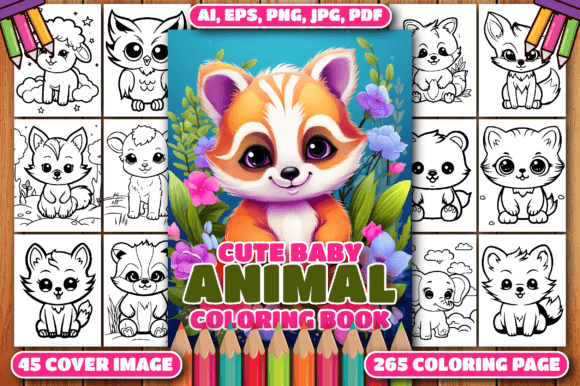
Animal Adventure Coloring Pages for Kids: A Practical Resource for Educators, Creators, and Families
Coloring isn’t just a pastime—it’s a foundational learning tool, a creative catalyst, and a quiet bridge to emotional regulation. When thoughtfully designed, coloring pages go beyond simple line art to support cognitive development, fine motor skill acquisition, and thematic literacy. The Animal Adventure Coloring Pages for Kids collection exemplifies this elevated purpose—not as isolated illustrations, but as a cohesive, production-ready resource built for real-world application across multiple domains.
What Makes These Pages Distinctive in Practice?
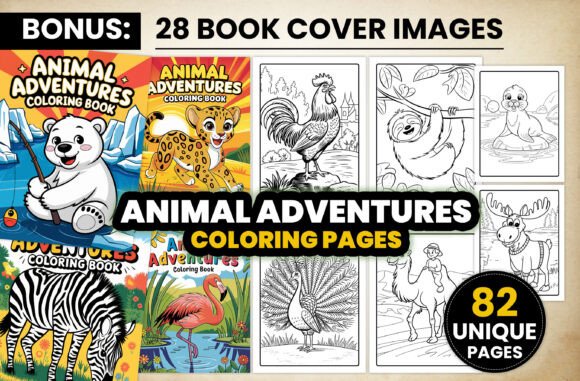
At first glance, the offering includes 82 original animal-themed coloring pages—but its utility emerges from structural intentionality. Each illustration is crafted as vector line art at 300 DPI, ensuring crisp scalability without pixelation whether printed at standard 8.5 x 11 inches or adapted for larger formats. Unlike raster-heavy bundles that degrade when resized, the included EPS files preserve editable paths, allowing designers to adjust stroke weight, isolate elements, or recolor linework—critical for customizing classroom handouts or adapting images for inclusive learners with visual processing needs.
The inclusion of both PNGs (with clean white backgrounds) and a ready-to-use PDF interior file means users aren’t forced into technical workflows unless they choose to be. A homeschool parent can open the PDF and print immediately. A KDP publisher can drop PNGs directly into Kindle Create or Adobe InDesign. An educator preparing a unit on habitats can extract individual animals—like the toucan for rainforest studies or the snow leopard for mountain ecosystems—and embed them into lesson slides or interactive notebooks without licensing ambiguity.
Educators and Curriculum Developers
In early childhood and elementary settings, animal-themed visuals anchor interdisciplinary learning. These Animal Adventure Coloring Pages for Kids support science standards around life cycles, classification, and adaptation—while simultaneously reinforcing vocabulary, sequencing, and observational drawing. For example, the page featuring a sea turtle hatchling emerging from sand invites discussion about marine biology, conservation status, and human impact. Teachers report higher engagement when students color while listening to read-alouds about migration patterns or ecosystem interdependence. The “Belongs To” page and color-testing sheet included in the bundle serve as low-stakes formative tools: children label their work, practice name recognition, or experiment with hue combinations before committing to final coloring—building ownership and metacognitive awareness.
KDP Publishers and Self-Publishing Entrepreneurs
For creators building activity books on Amazon KDP, consistency, compliance, and time-to-market are decisive factors. This collection delivers an interior-ready 84-page structure—including 82 unique animal illustrations plus two functional bonus pages—that aligns precisely with KDP’s trim size requirements (8.5 x 11 inches). No cropping, no reformatting, no guessing at margins. The 28 professionally designed book cover images—available in JPG and EPS—offer immediate options for A/B testing thumbnails, seasonal promotions (e.g., “Wildlife Wonders: Summer Edition”), or niche targeting (“Ocean Animals for Ocean Lovers”). Because all assets are original and royalty-free for commercial use, publishers avoid copyright clearance delays or takedown risks—especially important when scaling multiple titles in related categories like nature journals, therapy workbooks, or bilingual learning aids.
Families and Therapeutic Practitioners
Coloring has demonstrated utility in reducing anxiety, improving focus, and supporting sensory integration—particularly for neurodivergent children. The line weight and complexity across these pages vary intentionally: simpler outlines (e.g., ladybug, fox) suit younger or developing hands, while denser scenes (e.g., coral reef diorama, jungle canopy) offer sustained attention challenges for older kids or teens. Occupational therapists note that consistent exposure to structured yet imaginative tasks like coloring reinforces bilateral coordination and pencil control—skills that transfer directly to handwriting fluency. Importantly, the absence of text-heavy instructions or prescriptive color guides preserves open-endedness, encouraging self-expression over performance.
Technical Considerations That Impact Usability
Not all coloring page bundles are equal in execution—and subtle technical choices determine long-term flexibility. This set prioritizes interoperability:
- EPS source files allow full editing in Illustrator or Affinity Designer—ideal for adding labels, modifying proportions, or converting to cut files for Cricut/Silhouette machines.
- High-resolution PNGs eliminate transparency artifacts common in low-DPI exports, ensuring clean printing even on budget inkjet printers.
- The PDF interior uses embedded fonts and standardized bleed settings, minimizing KDP preflight errors—a frequent pain point for new publishers.
- All animal subjects reflect taxonomic accuracy in posture and anatomy (e.g., correct number of giraffe ossicones, distinguishing features between African and Asian elephants), supporting informal science education without oversimplification.
These aren’t stylistic flourishes—they’re operational safeguards. A researcher compiling visual materials for a study on animal representation in children’s media would value the diversity of species depicted (including lesser-known animals like the pangolin or okapi), while a small business owner creating branded educational kits appreciates the ability to overlay logos or custom headers onto the EPS base layers.
Integration Into Broader Creative Workflows
Users rarely deploy coloring pages in isolation. They’re often part of layered projects: a teacher designing a “Zoo Keeper’s Journal” unit might pair select pages with habitat maps, diet charts, and QR codes linking to wildlife documentaries. A content creator producing YouTube videos for kids could animate individual line drawings frame-by-frame using the PNG sequence. A nonprofit focused on conservation might adapt the panda or orangutan illustrations into advocacy posters—leveraging the vector files to add slogans or statistics without compromising image fidelity.
The 28 book cover images extend utility beyond interiors. They’re not generic templates—they’re conceptually aligned with the interior theme, using complementary palettes and consistent linework. One cover highlights silhouette-based minimalism (ideal for black-and-white printing), another employs soft watercolor textures (suited for premium editions), and several feature bold typography overlays—demonstrating how the same asset can serve different market segments: preschool audiences, ESL learners, or adult coloring enthusiasts seeking nostalgic themes.
Why Contextual Integrity Matters
Effective educational resources avoid tokenism. These Animal Adventure Coloring Pages for Kids represent animals within ecologically coherent contexts—not as floating icons, but as inhabitants of identifiable environments. The meerkat appears beside termite mounds; the penguin stands on textured ice; the monarch butterfly rests on milkweed leaves. Such contextual grounding supports narrative thinking and spatial reasoning. When children color a wolf howling beneath a full moon against pine silhouettes, they’re absorbing implicit information about nocturnal behavior, forest ecosystems, and seasonal cycles—even before formal instruction begins.
This attention to environmental fidelity also makes the collection adaptable for global audiences. Illustrations avoid culturally specific clothing, architecture, or signage—focusing instead on universal biological traits and natural settings. That neutrality expands accessibility for international educators, multilingual publishers, and NGOs operating across regions with varying curricular frameworks.
Strategic Use Beyond Immediate Output
Because the files are delivered in a ZIP folder with clearly labeled subdirectories (Interior_PDF, Covers_JPG, Vectors_EPS, PNG_WhiteBG), users can establish repeatable asset management systems. Design teams building multiple KDP titles can create master templates pulling from this library—ensuring brand consistency across product lines while reducing redundant illustration costs. Universities running continuing education courses for early childhood educators might license the bundle for classroom use, then task students with developing extension activities (e.g., “Create a matching game using the fox and rabbit pages”)—turning passive consumption into active pedagogical design.
Even researchers studying visual cognition in young children have cited similar high-fidelity line art collections for controlled stimulus presentation—where consistency in stroke width, contrast, and compositional balance eliminates confounding variables during data collection.
Final Observations on Sustainable Value
The longevity of this resource lies not in volume alone, but in versatility. Eighty-two pages may seem substantial—yet their true value multiplies through reuse, remixing, and repurposing. A single elephant illustration becomes a flashcard, a bulletin board border, a stitching pattern for textile arts, or a reference for clay modeling. The bonus book covers aren’t afterthoughts—they’re strategic entry points for audience segmentation and platform-specific optimization (e.g., vertical covers for TikTok promotion, square variants for Instagram carousels).
Ultimately, the Animal Adventure Coloring Pages for Kids collection functions less like a static product and more like a foundational toolkit—one that respects the varied expertise of its users, anticipates real constraints (time, software access, pedagogical goals), and delivers precision where it matters most: in the clarity of the line, the reliability of the format, and the authenticity of the subject matter.