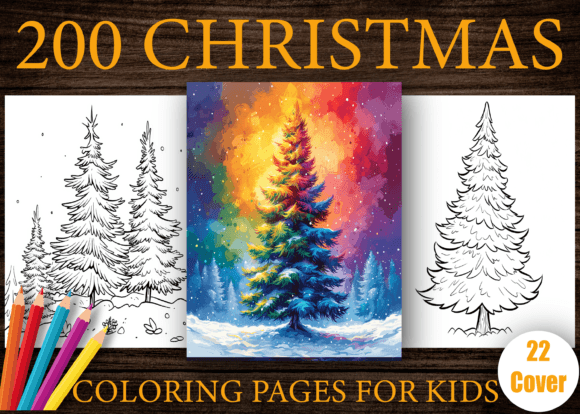
200 Christmas Tree Coloring Pages: A Creative Resource for Educators, Families, and Self-Publishers
Coloring is far more than a pastime—it’s a conduit for cognitive development, emotional regulation, and cultural engagement. When themed around enduring symbols like the Christmas tree, coloring transforms into a layered learning experience. The 200 Christmas Tree Coloring Pages collection stands apart not merely for its volume, but for its intentional design, technical readiness, and cross-context utility. Unlike generic holiday-themed sets, this resource was built with three distinct user groups in mind: early childhood educators seeking curriculum-aligned materials, families aiming for screen-free seasonal connection, and independent creators preparing professional-grade publications for platforms like Amazon KDP.
Why Christmas Trees? More Than Just Ornamentation
The Christmas tree functions as a visual anchor across cultures and generations—a symbol rich in symmetry, repetition, texture, and narrative potential. Its structural consistency (trunk, branches, tiered foliage) provides scaffolding for developing fine motor control in young children, while its decorative variability—stars, angels, baubles, lights, garlands, animals, and even fantasy elements—invites storytelling, pattern recognition, and symbolic interpretation. In classrooms, a single tree outline can support lessons in geometry (angles of branch divergence), color theory (complementary palettes for ornaments), sequencing (designing a “before and after” decoration timeline), or cultural studies (comparing Scandinavian Jul trees with Mexican Nacimiento motifs).
This depth is embedded throughout the 200 Christmas Tree Coloring Pages. Pages aren’t duplicated; instead, they progress in complexity—from simple silhouettes suitable for preschoolers to intricate mandala-style trees with interwoven vines and tessellated ornaments designed for older children and adult colorists. Some feature labeled parts (“trunk,” “bough,” “tinsel”) to reinforce vocabulary; others embed subtle math prompts (“count the red ornaments,” “color every third bulb yellow”). Such intentionality elevates the set beyond entertainment into pedagogical infrastructure.
Technical Specifications That Enable Real-World Use
For professionals—especially those working within publishing, education, or therapeutic settings—file integrity and flexibility are non-negotiable. The 200 Christmas Tree Coloring Pages deliver on this with precision:
- 300 DPI resolution across all formats: Ensures crisp lines whether printed on standard home printers or commercial offset presses—no pixelation, no loss of detail at scale.
- Three complementary file types: A single print-ready PDF (A4 / 8.5×11″), plus individual JPG and PNG files. The PNGs include transparent backgrounds, enabling seamless integration into digital lesson plans, interactive whiteboard activities, or custom app interfaces.
- KDP-optimized structure: The interior PDF follows Kindle Direct Publishing’s exact requirements—bleed-free margins, consistent page numbering, and embedded fonts where applicable—reducing upload rejections and formatting delays.
- 22 professionally designed book covers: Each cover uses high-resolution assets from the interior collection, maintaining visual continuity. Covers vary in tone—whimsical, minimalist, vintage, modern—to suit different audience segments (e.g., “Christmas Tree Coloring Pages For Toddlers” vs. “Holiday Mindfulness Coloring Book”).
This isn’t just convenience—it’s workflow efficiency. An educator can extract five PNGs for a Google Slides activity in under two minutes. A self-publisher can generate multiple KDP listings (different age brackets, themes, or regional variations) using the same core asset library, minimizing production overhead without compromising uniqueness.
Classroom Integration: From Quiet Time to Cross-Curricular Projects
In early elementary settings, the 200 Christmas Tree Coloring Pages serve dual roles: as calming sensory tools during transitions and as springboards for structured inquiry. Consider these implementations:
- Science Connection: Pair a page showing a bare pine tree with one depicting a fully decorated version. Students compare real conifer anatomy (needle clusters, bark texture, root systems) to stylized representations—sparking discussion about adaptation, photosynthesis in winter, and native species.
- Social Studies Extension: Assign students different global traditions—German tannenbaum, Ukrainian spider web legend, Filipino parol-adorned trees—and ask them to design a tree reflecting that culture using pages as templates. This fosters empathy and geographic literacy.
- Language Arts Scaffold: Use undecorated tree outlines as story maps. Children draw scenes from their own holiday memories or imagined narratives in each branch “section,” then write captions or short paragraphs describing each moment.
Crucially, the line art avoids over-detailing in foundational pages—allowing space for student interpretation rather than prescriptive coloring. This aligns with research on open-ended creative tasks enhancing executive function and divergent thinking.
Families and Caregivers: Building Ritual Through Repetition
Holiday seasons often bring heightened stress and fragmented attention. The 200 Christmas Tree Coloring Pages offer a low-barrier, high-reward ritual: 15 minutes of shared focus, free from screens or performance pressure. Because the collection spans developmental stages, siblings can work side-by-side on appropriately matched pages—no one feels “babyish” or overwhelmed. A toddler traces thick outlines while an older sibling adds shading techniques or designs custom ornaments in the margins.
Moreover, the physicality matters. Printed on high-quality paper (recommended 120 gsm or higher), the pages resist bleed-through from markers and hold up to erasing with colored pencils. The durable paperback binding—when compiled—ensures pages stay intact through repeated handling, making it viable for travel, waiting rooms, or multi-generational gatherings. Grandparents report using these pages as memory prompts: “Let’s draw the tree we had when you were five,” bridging generations through tactile, collaborative creation.
Self-Publishing and Commercial Applications
For creators entering the $1.5B+ global coloring book market, differentiation is critical. The 200 Christmas Tree Coloring Pages provide a turnkey foundation—not as a finished product, but as a vetted, production-ready asset library. Its value lies in modularity:
- Bundle Flexibility: Combine 50 tree pages with 30 snowflake designs and 20 reindeer illustrations to create a “Winter Wonderland Activity Pack”—all maintaining consistent DPI and sizing.
- Licensing Potential: Individual PNGs can be licensed for use in educational apps, printable planners, or SVG cut files for Cricut/Silhouette users—expanding revenue beyond static books.
- Localization Readiness: With no text embedded in most interiors, translation is straightforward. Publishers in Spanish-, French-, or Arabic-speaking markets can add culturally resonant instructions or holiday terms without redesigning artwork.
Importantly, the collection avoids copyright pitfalls common in holiday-themed assets. All illustrations are original—no clipart derivatives, no trademarked character likenesses, no ambiguous public domain reinterpretations. This mitigates takedown risk on major retail platforms and supports long-term brand trust.
Material Considerations for Optimal Outcomes
While the 200 Christmas Tree Coloring Pages excel technically, their impact depends on thoughtful implementation. Paper choice significantly affects usability: wax-based crayons perform best on uncoated stock, while alcohol-based markers demand bleed-resistant paper. Educators using these in bulk should test print samples before full runs—some home printers struggle with heavy ink coverage on intricate pages, leading to smudging or paper jams.
Similarly, digital usage requires attention to color profiles. Though the files are RGB-friendly, designers converting to CMYK for commercial printing should soft-proof first—certain metallic or neon ornament effects may shift subtly. The inclusion of both JPG and PNG ensures adaptability: JPG for smaller email attachments or LMS uploads; PNG when layering or transparency is needed.
Beyond the Season: Longevity and Adaptability
A common misconception is that Christmas-themed resources lose relevance after December. Yet the 200 Christmas Tree Coloring Pages demonstrate remarkable repurposability. The underlying forms—conical shapes, radial symmetry, branching structures—appear in botany units, geometry proofs, and even basic coding exercises (e.g., “draw a fractal tree using recursion”). Therapists use simplified tree outlines in emotion-regulation work (“add colors that match how you feel today”), decoupling the imagery from its holiday context entirely.
Even commercially, creators report success rebranding subsets year-round: “Forest Canopy Coloring Pages” (using evergreen-focused illustrations), “Symmetry & Structure Workbook” (highlighting geometric trees), or “Mindful Nature Journal Prompts” (pairing blank tree trunks with reflective writing cues). This longevity underscores a key principle—the strongest thematic resources aren’t locked to a calendar date, but anchored in universally resonant forms and functions.
In essence, the 200 Christmas Tree Coloring Pages represent a convergence of artistic clarity, technical rigor, and pedagogical insight. They meet users where they are—whether a teacher needing five minutes of calm, a parent seeking shared joy, or a publisher building scalable digital products—and equip them with tools that endure beyond the tinsel and lights.