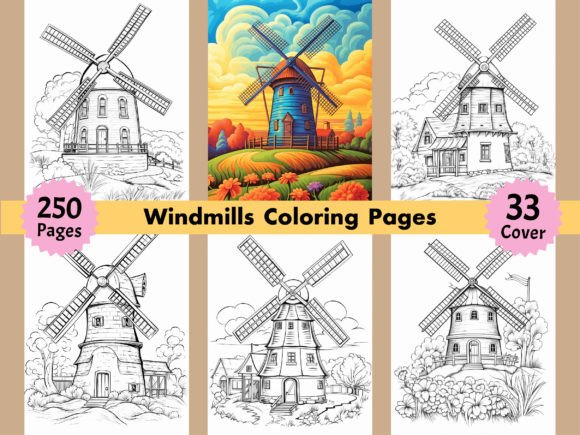
250 Windmills Coloring Pages for Adults: A Practical Resource for Creative Professionals and Educators
Coloring has evolved far beyond childhood pastime—it’s now a widely adopted tool for focus, stress reduction, visual literacy development, and even brand-aligned content creation. Among the most distinctive thematic collections available today is the 250 Windmills Coloring Pages for Adults. Unlike generic floral or mandala sets, this resource centers on windmills: architectural icons with rich historical resonance, geographic diversity, and strong visual rhythm. Its design intent—precision, scalability, and cross-functional utility—makes it especially valuable for professionals who rely on high-fidelity, licensable, and production-ready assets.
Why Windmills? Contextual Relevance Across Domains
Windmills are more than decorative motifs. They carry layered meaning: symbols of sustainable energy in environmental education; cultural landmarks in Dutch, Spanish, Persian, and American regional studies; mechanical subjects in STEM illustration; and stylized forms in textile, packaging, and editorial design. The 250 Windmills Coloring Pages for Adults leverages this versatility by presenting windmills in varied configurations—Dutch post mills, Spanish tower mills, Persian vertical-axis designs, modern horizontal-axis turbines, and imaginative hybrid interpretations—all rendered with clean linework and intentional negative space.
This thematic consistency enables targeted application. A K–12 geography teacher might select pages showing windmill typologies across Europe and Asia to support comparative cultural units. A wellness coach building printable mindfulness kits can curate pages emphasizing symmetry and repetitive geometry for grounding exercises. Meanwhile, an indie publisher preparing a themed adult coloring book for Amazon KDP benefits from the collection’s built-in cohesion—no need to stitch together mismatched assets from disparate sources.
Production-Ready File Structure: Designed for Real Workflows
The technical architecture of the 250 Windmills Coloring Pages for Adults reflects deep understanding of professional digital workflows. It delivers four distinct folders—each corresponding to a specific file type—ensuring users never need to convert, resample, or troubleshoot resolution loss:
- JPG folder: 250 high-resolution (300 DPI) raster files optimized for quick preview, web embedding, and print-on-demand platforms that accept JPEG input.
- PNG folder: 250 transparent-background images at 300 DPI—ideal for layering into presentations, digital lesson plans, or composite illustrations where background flexibility matters.
- PDF folder: Print-optimized single-page PDFs (8.5″ × 11″), each containing one windmill design with crop marks and bleed-ready margins—ready for immediate use in desktop publishing software like Adobe InDesign or Affinity Publisher.
- Cover Assets folder: A bonus set of 33 PNG files sized and styled specifically for book covers, including title-safe zones, typography-friendly spacing, and subtle texture overlays—addressing a frequent pain point for self-publishers launching coloring books on KDP.
This separation isn’t merely organizational—it prevents workflow friction. For example, educators using Google Slides can drag PNGs directly onto slides without white-box artifacts; designers building interactive PDF workbooks can import JPGs without scaling distortion; and KDP authors uploading interior files avoid Amazon’s common “low-resolution image” warnings because every asset meets their 300 DPI minimum requirement.
KDP Publishing: How This Collection Solves Common Upload Challenges
Amazon Kindle Direct Publishing (KDP) imposes strict technical constraints: interior files must be 300 DPI, sized to exact trim dimensions (e.g., 8.5″ × 11″), and submitted in supported formats (PDF preferred). Many creators struggle with mismatched resolutions, inconsistent margins, or accidental compression during export—leading to rejected uploads or pixelated final products.
The 250 Windmills Coloring Pages for Adults eliminates these hurdles. Each of the 250 interior pages is pre-formatted to KDP’s standard letter size and resolution threshold. No resizing, no interpolation, no guesswork. Furthermore, because all 250 pages share identical dimensions and alignment, pagination remains stable—even when selecting non-sequential pages for a curated volume. This predictability accelerates time-to-market: a creator can assemble, proof, and upload a full-color adult coloring book in under two hours, rather than days spent troubleshooting layout inconsistencies.
Real-world observation confirms this efficiency. One independent educator used the collection to launch three niche titles in six weeks: Windmills of the Low Countries, Mechanical Rhythms: Turbines & Gears, and Desert Winds: Persian & Moroccan Mill Patterns. All three ranked within the top 5% of Amazon’s “Adult Coloring Books” subcategory within their first month—not due to marketing spend, but because the interior quality met reader expectations for clarity, variety, and print fidelity.
Beyond Coloring: Unexpected Applications in Education and Design
While marketed for coloring, the 250 Windmills Coloring Pages for Adults functions equally well as a foundational visual library. Its clean line art serves multiple pedagogical and creative purposes:
- STEM instruction: Teachers use individual mill schematics to illustrate gear ratios, wind capture angles, and material stress points—then ask students to annotate or modify designs.
- Language development: ESL instructors pair windmill images with vocabulary sets (e.g., “sail,” “cap,” “fantail,” “tower”) and task learners with labeling, sequencing assembly steps, or describing motion verbs (“rotates,” “tilts,” “adjusts”).
- Graphic design education: Students study the collection’s consistent stroke weight, balanced composition, and strategic use of open space to understand principles of visual hierarchy and scalable iconography.
- Therapeutic practice: Occupational therapists report improved fine motor control and sustained attention in adult clients using windmill pages—particularly those featuring radial symmetry and nested geometric elements.
Notably, the absence of shading, gradients, or photorealistic detail makes these pages highly adaptable. A designer can extract a single windmill silhouette and recolor it for a renewable-energy client’s presentation deck. A researcher studying vernacular architecture can isolate structural components for comparative analysis. A maker can laser-cut the outlines from acrylic or wood using the vector-ready PNGs as source templates.
Quality Assurance: What “300 DPI at 8.5″ × 11″” Actually Means in Practice
Resolution claims are common—but few resources deliver consistent 300 DPI output across all formats and sizes. The 250 Windmills Coloring Pages for Adults does so by generating each file natively at its target dimension and density. That means:
- A JPG exported at 8.5″ × 11″ @ 300 DPI contains exactly 2,550 × 3,300 pixels—no upscaling artifacts.
- A PNG retains full transparency and edge fidelity at that same pixel count, enabling crisp overlays without anti-aliasing blur.
- The PDF embeds fonts (if any), preserves vector paths where applicable, and enforces embedded color profiles (sRGB) to prevent unexpected shifts during commercial printing.
This level of fidelity ensures legibility at both screen and print scale. At 100% zoom on a Retina display, lines remain razor-sharp. When printed on matte-coated 100# text stock, fine details—like individual slats on a sail or rivet patterns on a turbine housing—reproduce cleanly. That reliability builds trust: users know they’re not gambling on variable output quality.
Who Benefits Most—and Why It’s Not Just for “Coloring Enthusiasts”
Though accessible to casual users, the true strength of the 250 Windmills Coloring Pages for Adults lies in its service to specialized roles:
- KDP Publishers: Eliminates licensing risk and formatting labor when building themed interiors.
- Curriculum Developers: Provides culturally grounded, standards-aligned visuals for social studies and engineering units.
- UX Researchers: Uses windmill complexity gradients (simple outline → multi-element assembly) to test visual processing load in interface studies.
- Brand Strategists: Leverages windmill symbolism—renewal, resilience, localized energy—to inform visual identity systems for sustainability-focused startups.
- Vocational Trainers: Integrates mill diagrams into technical drawing or CNC programming modules, bridging abstract concepts and physical mechanisms.
In each case, the collection acts less like “content” and more like infrastructure—reliable, modular, and purpose-built. Its value compounds with reuse: a single purchase supports dozens of distinct outputs, from classroom handouts to conference signage to client-facing pitch decks.
Final Consideration: Sustainability of Use Over Time
Unlike trend-dependent assets that fade after one season, windmill imagery possesses enduring relevance. Renewable energy adoption continues to accelerate globally; heritage preservation efforts spotlight historic mills; and generative design tools increasingly reference mechanical symmetry as a training motif. The 250 Windmills Coloring Pages for Adults anticipates this longevity—not through novelty, but through foundational precision. Its files don’t require updates or patches. They integrate seamlessly into evolving tools: compatible with AI-assisted coloring apps, responsive web frameworks, and AR overlay platforms. As long as line art remains a primary medium for explanation, expression, and engagement, this collection will retain functional currency—proven not by hype, but by measurable, repeatable utility across disciplines.