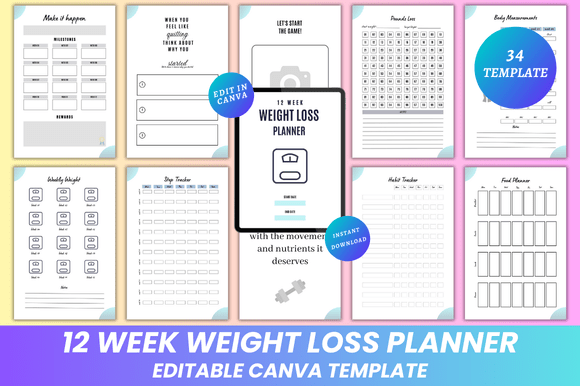
12 Week Weight Loss Planner Canva KDP: A Fully Customizable, Print-Ready System for Sustainable Progress
Weight loss isn’t a sprint—it’s a structured, reflective, and deeply personal journey. What separates lasting change from short-lived effort is consistency, intentionality, and tools that adapt to your evolving needs. The 12 Week Weight Loss Planner Canva KDP meets that need precisely: it’s not a static PDF checklist or a rigid journal, but a dynamic, editable framework built for real-life flexibility and measurable growth. Designed with creators, educators, wellness professionals, and self-directed learners in mind, this planner bridges the gap between digital convenience and tangible accountability—without sacrificing design integrity or functional depth.
Why Editability Isn’t Optional—It’s Essential
One-size-fits-all weight loss templates often fail because they ignore individual rhythms: a teacher’s schedule differs from a remote software engineer’s; a parent managing childcare has different energy windows than a retiree rebuilding habits. The Editable Canva Link included with every 12 Week Weight Loss Planner Canva KDP interior transforms passive consumption into active co-creation. You’re not just filling in blanks—you’re reshaping the tool itself. Adjust font sizes for readability during early-morning planning sessions. Swap color palettes to align with your brand (if reselling) or personal motivation cues (e.g., calming blues for stress-sensitive users, energizing greens for fitness-focused goals). Resize habit tracker grids to accommodate more nuanced behaviors—like “drank 2L water” alongside “practiced mindful breathing for 5 minutes.” Even layout style can shift: convert a two-column weekly spread into a vertical scroll format optimized for tablet use—or revert to a classic left-right print layout for home printing.
This level of control matters because behavior change research consistently shows that ownership increases adherence. When users customize visual elements, they subconsciously reinforce commitment. A study published in the Journal of Medical Internet Research found that participants who personalized their digital health tools demonstrated 37% higher 12-week retention rates than those using default interfaces. That principle scales seamlessly to the 12 Week Weight Loss Planner Canva KDP—where editing isn’t a technical afterthought, but the foundational design philosophy.
From Tracking to Transformation: The Functional Architecture
The interior structure of the planner reflects evidence-based behavior change models—notably the Transtheoretical Model (Stages of Change) and Self-Determination Theory. Rather than beginning with calorie counts or workout logs, it opens with psychological grounding: the Belongs To page invites personal inscription, anchoring ownership; When You Feel Like prompts honest emotional reflection before action; and the dual affirmations—Let’s Start The Game Before and A Better Version Of Me After—frame progress as identity evolution, not just numerical reduction.
Measurement is intelligently segmented across timeframes to prevent overwhelm and highlight trends:
- Body Measurements Week 1–Week 4, Week 5–Week 8, and Week 9–Week 12 allow granular observation of non-scale victories—waist circumference shifts, improved posture, clothing fit changes—while avoiding daily fixation.
- The Body Measurements Start–End–Goal page provides longitudinal context, helping users recalibrate expectations when plateaus occur.
- Weekly Weight logging includes space for notes on hydration, cycle phase (for menstruating users), or recent travel—factors that impact scale readings but rarely appear in generic trackers.
But weight and measurements are only part of the story. The planner embeds holistic health metrics without clutter: a clean Step Tracker and Sleep Tracker sit adjacent to weekly reflections, reinforcing that movement and rest are interdependent pillars—not optional extras. Each week begins with a mindset statement (“Week 1: I Am Confident In My Ability To Lose Weight”, “Week 2: I Am Not Perfect, But I Am Doing The Best That I Can”)—a subtle yet powerful nudge toward self-compassion, a predictor of long-term success according to clinical psychology literature.
Planning Layers That Work Together—Not Against Each Other
Where many planners silo food, fitness, and habits, this system layers them intentionally. The Habit Tracker doesn’t just list behaviors—it maps them to time of day (morning/afternoon/evening), supporting implementation intention theory (“If it’s 7 a.m., then I’ll drink lemon water before coffee”). The Food Planner integrates seamlessly with the Grocery List: items added to meal plans auto-suggest entries for shopping—though manually editable to reflect pantry inventory or seasonal availability. Likewise, the Fitness Planner links to the Calorie Tracker not through rigid formulas, but via contextual fields: “Estimated calories burned (based on duration & perceived exertion)” encourages intuitive awareness over obsessive calculation.
This integration mirrors how people actually live. A busy small-business owner might batch-cook Sunday meals while scheduling 10-minute mobility drills between client calls—both captured meaningfully in one spread. A college student tracking sleep for academic performance can correlate rest quality with next-day focus levels in the margin notes section. The 12 Week Weight Loss Planner Canva KDP doesn’t demand perfection; it supports pattern recognition.
Production-Ready Output for Diverse Use Cases
Creators leveraging the 12 Week Weight Loss Planner Canva KDP for KDP publishing receive more than a design—they get production-grade assets. The High-Quality Print Ready PDF files are pre-formatted to 6.125 × 9.25 inches—the industry standard for digestible, shelf-friendly paperbacks—complete with bleed-safe margins and CMYK color profiles. For hybrid workflows, accompanying JPG and PNG files enable quick social media previews, email newsletter visuals, or instructor handouts. Educators can extract single pages (e.g., the Sleep Tracker) as standalone classroom worksheets; researchers studying habit formation may anonymize and aggregate data from printed versions across participant cohorts.
Print-at-home users benefit from crisp vector-based text and scalable graphics—no pixelation when enlarging charts for accessibility. Print-shop clients appreciate embedded fonts and flattened layers, eliminating prepress delays. And because every element remains editable in Canva until final export, last-minute adjustments—like adding a local nutritionist’s contact info to the Grocery List page or translating affirmations into Spanish for bilingual communities—are frictionless.
Design Integrity Meets Practical Intelligence
Unlike minimalist planners that sacrifice utility for aesthetics—or dense trackers that overwhelm with data points—this interior balances visual clarity with functional density. White space is purposeful, not decorative: it creates breathing room between the Pounds Loss summary and the Weekly Weight chart, reducing cognitive load. Icons are consistent and intuitive (a moon for sleep, a footprint for steps), supporting rapid scanning. Typography hierarchy guides attention: bold headings establish sections, medium-weight subheads differentiate inputs (e.g., “Actual Weight” vs. “Target Range”), and light-gray placeholder text gently suggests usage without prescriptive tone.
That balance extends to inclusivity. Measurement fields accommodate metric and imperial units without reformatting. The Food Planner avoids prescriptive language like “good/bad foods,” instead prompting “What nourished me today?” and “What energized my body?”—aligning with Health at Every Size® principles. Affirmations avoid appearance-focused language (“I’ll be slimmer”) in favor of agency and resilience (“I will make healthy choices for my body”), reflecting current best practices in clinical nutrition counseling.
Real-World Implementation Across Audiences
For creators, the 12 Week Weight Loss Planner Canva KDP serves as both product and prototype—its editable nature allows rapid iteration based on customer feedback (e.g., adding a “Medication Tracker” tab after user requests). Educators repurpose pages for health literacy units, using the Habit Tracker to teach behavioral psychology concepts. Wellness coaches white-label the interior, inserting their logo and signature coaching questions into the When You Feel Like section. Even researchers use anonymized printed versions in longitudinal studies, appreciating the standardized yet adaptable structure for qualitative data capture.
Ultimately, this isn’t about achieving an arbitrary number on a scale. It’s about building systems that honor complexity—your schedule, your physiology, your values. The 12 Week Weight Loss Planner Canva KDP succeeds because it treats planning not as a constraint, but as a creative act—one where every font choice, color adjustment, and handwritten note reinforces the quiet certainty that sustainable change begins not with deprivation, but with thoughtful, editable, human-centered design.