Math Activity Worksheets for Kids Part-1: Practical, Print-Ready Learning You Can Use Today
If you've ever scrambled before a homeschool lesson, stood in front of a restless kindergarten class with five minutes to fill, or tried to keep a curious 5-year-old engaged during a rainy afternoon—then Math Activity Worksheets for Kids Part-1 isn’t just another digital download. It’s a quietly powerful tool that fits into real life, not just lesson plans.
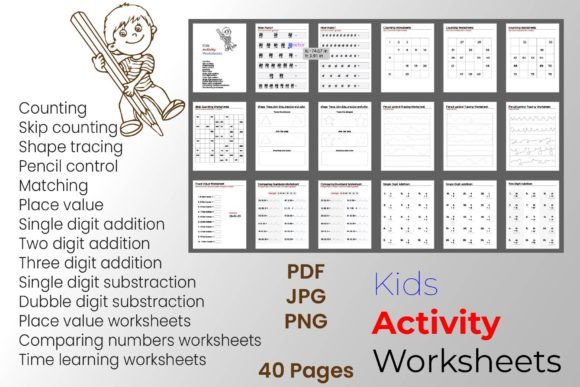
This collection was built for people who need clarity—not complexity. Whether you’re a parent juggling remote learning and work, a preschool teacher refreshing your resource library, or an indie publisher preparing KDP-ready educational content, these worksheets meet you where you are. They’re not theory. They’re 40 ready-to-print PDF pages (plus matching JPG and PNG files), designed to work immediately—with no editing, no formatting headaches, and no “bleed” issues that ruin print margins.
Where These Worksheets Actually Fit Into Daily Life
Think about the last time you needed math practice that didn’t require Wi-Fi, batteries, or screen time. Maybe it was on a road trip, waiting at the pediatrician’s office, or during a quiet morning routine before school started. That’s where Math Activity Worksheets for Kids Part-1 shines: as low-friction, high-engagement material that supports learning without demanding setup.
A freelance early childhood educator uses the dot-to-dot counting games as warm-up activities before circle time—students arrive, grab a pencil, and start connecting numbers while settling in. A small business owner selling printable bundles on Etsy layers the shape tracing and pencil control worksheets into a “Back-to-School Fine Motor Kit,” adding value without creating from scratch. And a homeschooling parent rotates the comparing worksheets and place value sheets into weekly “math centers,” letting kids choose their challenge—building autonomy alongside numeracy.
Why “Easy to Use” Means More Than Just “Print and Go”
“Easy to use” here isn’t marketing speak—it’s baked into design decisions. The no-bleed layout means every worksheet prints cleanly on standard US letter or A4 paper, even on home printers. The KDP-tested format tells you these pages have already passed Amazon’s strict interior requirements—so if you’re building your own workbook or activity bundle, you’re skipping hours of troubleshooting. And because each file comes in three formats (PDF, JPG, PNG), you can drop them into Canva for custom covers, embed them in Google Slides for hybrid teaching, or convert them to interactive PDFs using free tools.
The variety isn’t random—it maps to developmental progression and classroom pacing. You’ll find single-digit addition next to triple-digit subtraction, not because they’re grouped by difficulty alone, but because real teaching often requires tiered support. One child might reinforce number bonds with the counting worksheets, while another extends thinking with the time learning worksheet that ties analog clocks to half-hour increments—all in the same printable set.
Real Scenarios Where These Make a Difference
- Small-group intervention: A Title I tutor pulls the matching game worksheets to build number-word association with second graders behind in fluency. No prep, no laminating—just print, cut, and go.
- Digital product creation: A Canva template seller adds the skip counting and double-digit addition pages to a “Summer Math Boost” digital planner—enhancing perceived value without increasing workload.
- Therapy & OT support: An occupational therapist uses the pencil control worksheet series to gently strengthen hand muscles before moving to writing drills—because fine motor development is math-adjacent, not separate.
- Classroom sub plans: A fourth-grade teacher leaves the comparing worksheets and place value pages with a substitute—clear instructions, self-checking potential, and zero tech dependency.
What to Consider Before Using or Sharing These Worksheets
These aren’t meant to replace curriculum—but to support it. If you’re evaluating whether Math Activity Worksheets for Kids Part-1 fits your needs, ask yourself: Do I need flexibility across skill levels? Will I use this digitally, in print, or both? Am I looking for supplemental reinforcement—or foundational scaffolding?
For educators: These work best when paired with brief verbal framing (“Let’s count together before you connect the dots”) or quick peer discussion (“How did you decide which number is bigger?”). For creators: The clean, uncluttered design gives you room to add branding, instructions, or extension questions—without fighting the layout.
Also worth noting: While the set includes time learning, shape tracing, and counting worksheets, it doesn’t cover advanced topics like fractions or multiplication tables—that’s intentional. This is Part-1: focused, scoped, and built to deliver consistent, confidence-building wins—not overwhelm.
How Different Users Get Different Value From the Same Pages
A blogger writing about “low-prep STEM activities for toddlers” might spotlight the dot-to-dot and matching game worksheets as playful gateways to pattern recognition. A KDP publisher could combine the triple-digit addition and subtraction pages with original word problems to create a grade-specific workbook. A grandparent helping with summer review might simply print the skip counting and place value sheets—two pages, one pencil, and 20 focused minutes.
Even the file types serve different purposes: PDFs for printing, JPGs for social media snippets (“Here’s how we practiced tens and ones today!”), PNGs for transparent overlays in digital planners or newsletters.
One Last Thought—Before You Click “Add to Cart”
If you’ve downloaded printables before only to find blurry fonts, misaligned grids, or layouts that don’t survive a home printer—this set was made to fix that. It’s tested, consistent, and quietly thoughtful: the kind of resource that earns a spot in your “go-to folder,” not your “might-use-someday” archive. And if you appreciate how something as simple as a well-spaced comparing worksheet can reduce student frustration—or how a clean time learning worksheet helps kids internalize daily rhythms—then this isn’t just paper. It’s peace of mind, one math concept at a time.
If you like our work, follow us so you’ll get notified when we upload new products—including themed sets, seasonal variations, and companion literacy packs. You’ll also find more practical, classroom-tested resources in our other listings. Thank you for supporting thoughtful, usable learning tools.