Boho House Plants Lineart Graphic
If you’ve ever scrolled through a Cricut design space, opened a KDP interior file, or sketched out a new pillow mockup—and paused at that clean, breezy sketch of a fiddle-leaf fig in flowing line art—you’ve likely stumbled upon the quiet magic of Boho House Plants Lineart Graphic. It’s not just another clipart pack. It’s a ready-to-deploy visual language for makers who want warmth, texture, and intentionality—without spending hours drawing from scratch.
What It Actually Is (and Why That Matters)
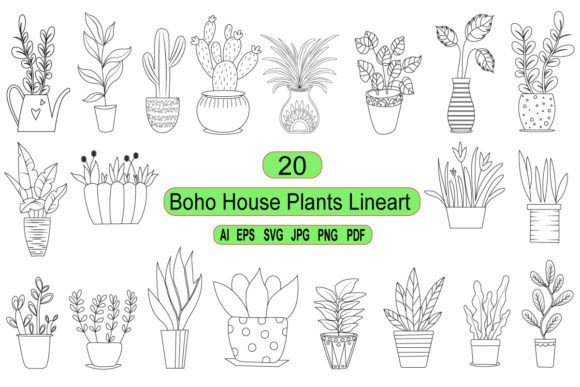
This isn’t a photo of a plant. It’s not a watercolor overlay or a busy pattern. Boho House Plants Lineart Graphic is a vector-based, black-and-white contour sketch—clean, scalable, and intentionally minimal. Think of it like the pencil outline before color or shading: precise enough for cutting on a Cricut or Silhouette, flexible enough to resize for a mug or a wall decal, and simple enough to color by hand in an adult coloring book.
The bundle includes 20 unique plant designs—monstera, snake plant, hanging pothos, ceramic pots with trailing vines—all drawn as cohesive line art. Each comes in AI, SVG, PDF, JPG, PNG (300 ppi + transparent background), and EPS10 formats. That means whether you’re using Adobe Illustrator, Canva, Cricut Design Space, or even Procreate (via SVG import), you’re covered—not as a technical afterthought, but by design.
Where People Really Use These Files (Not Just “For Crafts”)
Let’s talk about real moments—not hypothetical ones.
- A small-batch apparel seller uses the potted fern SVG to layer onto a cream-colored sweatshirt mockup, then uploads it directly to Printful. No tracing, no licensing worries, no pixelation when scaled up. She ships her first “Plant Mom Life” collection in under 48 hours.
- A KDP publisher building a boho-themed adult coloring book drops five of the line art files into InDesign, adjusts spacing for bleed and margins, and exports a print-ready PDF. Because each image is vector-based and isolated on white, there’s zero cleanup needed—no stray pixels, no background shadows, no manual erasing.
- A middle school art teacher pulls the monstera line art into Google Slides, adds a “draw your own pot” prompt, and projects it during a lesson on negative space and contour drawing. Students trace, then ink, then add their own patterns—no copyright concerns, no download barriers.
- A wedding planner designing custom napkin prints pulls the trailing pothos SVG into a Canva template, recolors it sage green, and orders a run of 100 linen napkins. The line art reads clearly at 2 inches wide—and stays crisp even when embroidered later.
Why Format Variety Isn’t Just a Checkbox
You don’t need all seven formats—but you *will* need more than one. Here’s how it plays out:
- SVG files go straight into Cricut Design Space for cutting vinyl or iron-on. They retain layers, so you can separate leaves from pots if you want to rearrange elements.
- PNGs with transparent backgrounds drop cleanly into social media graphics—say, a cozy Instagram Story promoting your new plant-themed candle line.
- AI and EPS files let designers tweak anchor points, adjust stroke weight, or convert outlines to paths—useful if you’re adapting the line art for laser engraving on wood coasters.
- JPGs are ideal for quick client proofs or blog post visuals—no software required to open them.
That flexibility matters when your workflow shifts mid-project—like when you start designing for mugs but pivot to printable greeting cards. You’re not restarting. You’re reusing, resizing, and repurposing.
What to Consider Before You Download or Use It
Not every line art bundle fits every need—even a well-made one like Boho House Plants Lineart Graphic. Ask yourself:
- Is this for commercial use? Yes—it’s licensed for both personal and commercial projects, including physical products (t-shirts, mugs, stickers) and digital goods (e-books, Canva templates, teaching resources). But resale of the raw files themselves isn’t allowed—so no uploading the SVGs to Etsy as standalone clipart.
- Do I need color or texture? This is strictly line art. There’s no shading, no gradients, no botanical realism beyond silhouette and flow. If you want watercolor-style plants, this isn’t the bundle—but if you want clean, adaptable outlines to build upon, it’s spot-on.
- How much editing do I plan to do? If you’re comfortable opening SVGs in vector editors—or happy using Cricut’s built-in tools—you’ll get full value. If you only work in Word or basic Canva, stick to the PNGs or JPGs, and know that fine-tuning strokes or joins won’t be possible without compatible software.
Realistic Outcomes, Not Just Features
People don’t buy line art for “vector scalability.” They buy it because they want to ship a product faster, finish a client project without stock-image guilt, or make something feel handmade—even when time is tight. With Boho House Plants Lineart Graphic, that looks like:
- A blogger adding custom plant illustrations to her free downloadable “Indoor Plant Care Checklist”—instead of using generic icons that look like clipart from 2007.
- A coffee shop owner printing the line art onto kraft paper bags, then stamping them with a custom logo—giving takeout orders a tactile, earthy feel.
- An educator creating a sensory bin label set: each plant SVG printed, laminated, and paired with real dried leaves or faux vines for a Montessori-aligned botany station.
- A freelance designer delivering a full brand kit—including pattern swatches built from rotated and mirrored versions of the same snake plant line art—so the client gets cohesion across merch, web, and packaging.
None of those outcomes rely on complexity. They rely on clarity, consistency, and quiet versatility—the kind that lets the maker stay focused on meaning, not mechanics.
Final Thought: It’s About Momentum, Not Perfection
You don’t need to master every format or use every file. Start with one plant. Try it on a t-shirt mockup. Drop it into a Canva invitation. Print it, color it, scan it back in, and use it as a textured overlay. Boho House Plants Lineart Graphic works best when treated not as a static asset—but as a quiet collaborator in your making process. One that shows up ready, stays out of the way, and leaves room for your voice to come through.