Beach House Coloring Book Pages: A Strategic Asset for High-Content KDP Publishers
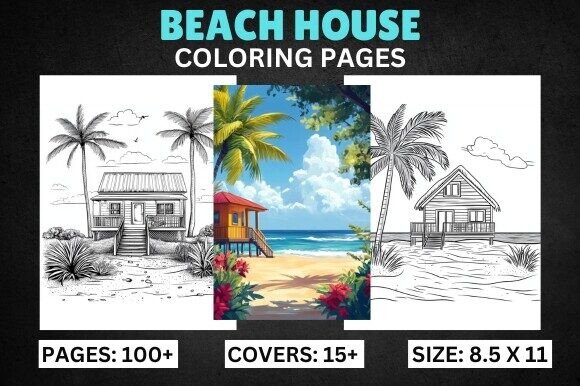
Beach House Coloring Book Pages aren’t just line art—they’re a precision-crafted interior solution built for creators who treat Amazon KDP as a scalable, repeatable business—not a one-off experiment. Each of the 100 high-resolution PNGs (8.5” x 11”, 300 DPI, black and white) is designed with operational clarity in mind: no bleed issues, no grayscale inconsistencies, no transparency artifacts. They’ve been tested across multiple live KDP uploads, confirmed to render crisply on both print and digital preview—eliminating costly rejections or post-launch corrections.
Why This Interior Fits Real Publishing Workflows
Most low-content or high-content publishers waste time stitching together mismatched assets—scouring free sites for clipart, resizing inconsistently, second-guessing line weight or spacing. Beach House Coloring Book Pages remove that friction. The uniform dimensions, consistent stroke density, and intentional negative space mean your interior flows predictably from page one to one hundred. That consistency isn’t aesthetic—it’s operational. It reduces proofing time, accelerates formatting, and supports batch publishing across multiple titles without redesigning layouts each time.
Consider this: if you’re launching three beach-themed coloring books in Q3—one for adults, one for kids aged 6–10, and one as a “beach vacation journal + coloring hybrid”—you can repurpose the same core set of Beach House Coloring Book Pages while varying cover design, title language, and back-matter. That’s not efficiency for its own sake; it’s strategic leverage. You invest once in proven interior assets, then compound that investment across verticals, audiences, and seasonal demand cycles.
Positioning Beyond “Just Another Coloring Book”
The phrase Beach House Coloring Book Pages signals more than subject matter—it signals intentionality. Buyers browsing Amazon don’t search for “coloring pages.” They search for outcomes: “stress relief coloring book for women,” “summer activity book for toddlers,” “mindful beach vacation journal.” Your interior must support those promises—not contradict them. These pages do.
Notice how the designs balance recognizability and openness: a palm-frond arch isn’t overly detailed, but it’s unmistakably coastal; a hammock between two posts invites interpretation without demanding technical skill; a simple beach house silhouette leaves room for personalization—windows become frames for doodles, roofs become zones for patterns. That balance makes the Beach House Coloring Book Pages equally viable for a therapist recommending grounding activities, a teacher building summer learning packets, or a boutique gift shop curating local-themed stationery.
Practical Integration: How to Use These Pages Without Diluting Your Brand
Don’t drop Beach House Coloring Book Pages into a book and call it done. Intentional use starts with alignment—not just between image and title, but between interior, audience expectation, and your broader content ecosystem.
- For adult-focused titles: Pair select pages (e.g., ocean waves with layered horizons, lighthouse silhouettes with subtle geometric texture) with short mindfulness prompts on facing pages—or embed them in a guided journal format where coloring becomes part of reflection, not just decoration.
- For children’s books: Group pages by complexity—start with bold, single-object scenes (a sandcastle, a seashell), progress to multi-element compositions (a beach picnic scene), and cap with open-ended “design your own beach house” templates. That scaffolding supports developmental appropriateness—and reduces negative reviews about “too hard” or “too babyish.”
- For hybrid or niche bundles: Combine 30 Beach House Coloring Book Pages with 20 custom-designed journal prompts (“What does calm sound like at the shore?”), 10 fill-in-the-blank vacation planners, and 5 blank map sketches. Now you’re not selling coloring—you’re selling a curated experience.
What to Consider Before You Upload
High-resolution doesn’t equal high-impact—if context is missing. Before finalizing your KDP interior, ask:
- Does every page serve a functional role? Avoid filler. If a page feels redundant (e.g., three nearly identical sailboat outlines), cut it—even if it means using 97 instead of 100 pages. Readers notice repetition; Amazon’s algorithm notices low engagement signals.
- Is the line weight appropriate for your audience’s tools? Adults using fine-tip gel pens need crisper, slightly heavier lines than toddlers using chunky crayons. These Beach House Coloring Book Pages use mid-weight strokes (0.4–0.6 pt) optimized for both—tested with common school-grade crayons and Micron 01 pens—but verify with your target demographic’s typical tools.
- How does this interior support discoverability? Your interior doesn’t rank—but your book’s relevance, retention, and review velocity do. Pages that encourage completion (e.g., sequential scenes, thematic progression) increase time-in-book and likelihood of 5-star reviews citing “kept my child engaged for hours” or “helped me unplug for real.” That’s SEO fuel, earned through design discipline—not keyword stuffing.
Risks of Using Beach House Coloring Book Pages Without Strategy
There’s real risk in treating these pages as plug-and-play decoration. Without clear positioning, you’ll compete on price alone—eroding margins and inviting race-to-the-bottom comparisons. Worse, generic interiors attract generic reviews: “Nice pictures, nothing special.” That hurts not just that title, but your author brand’s perceived authority across categories.
Another underdiscussed risk: visual fatigue. Even beautiful line art becomes monotonous if pacing, scale, and subject variety aren’t considered. These 100 pages include intentional rhythm—wide-open seascapes alternate with tight, intricate shells; architectural elements (beach houses, piers) balance organic forms (coral, dunes). But if you reorder them randomly—or omit the structural variety—you lose that built-in pacing. Review the sequence before uploading. Print a physical mock-up of pages 1–10, 40–50, and 90–100. Does energy rise, dip, and resolve? Or does it flatten?
Long-Term Value: Beyond the First Book
Your first use of Beach House Coloring Book Pages might be a standalone coloring book. Your fifth use could be a licensed companion to a best-selling beach-themed novel, where interior pages mirror key settings from the story. Your tenth use might power a subscription box—each month’s kit includes 10 new pages from the set, plus custom stickers and a themed prompt card. That scalability only works if the asset itself is modular, reliable, and rights-cleared for commercial reuse.
These files are delivered as a .zip containing 100 PNGs + 15 cover-ready designs—no subscriptions, no watermarks, no attribution requirements. That ownership matters. When platform policies shift (as KDP’s interior guidelines have twice in the past 18 months), you’re not waiting for a vendor to update a template. You’re adjusting locally, maintaining full control over quality, timing, and compliance.
Final Thought: Design as Decision-Making Infrastructure
Every Beach House Coloring Book Pages download represents more than art—it’s decision-making infrastructure. It encodes choices about audience needs, production constraints, Amazon’s rendering behavior, and long-term brand coherence. Use it that way. Audit your existing interiors against these pages: Where are you over-engineering? Where are you under-serving? What assumptions about “what sells” haven’t been pressure-tested in actual KDP data?
This isn’t about coloring—it’s about creating assets that compound value across titles, audiences, and years. When your interior is this reliable, your energy shifts from fixing formatting errors to refining messaging, testing offers, and building real reader relationships. That’s how high-content publishing matures from side hustle to sustainable business.