213 Summer Picnic Scene Coloring Pages: A Versatile Digital Resource for Creativity, Commerce, and Calm
Coloring has evolved far beyond childhood pastime—it’s now a widely recognized tool for stress reduction, cognitive engagement, and expressive exploration. At the intersection of art therapy, digital publishing, and entrepreneurial opportunity lies a distinctive resource: the 213 Summer Picnic Scene Coloring Pages collection. This isn’t just another set of line art illustrations; it’s a thoughtfully scaled, production-ready bundle designed with multiple stakeholders in mind—adult colorists seeking mindful focus, independent creators building KDP catalogs, educators integrating visual literacy into summer programming, and small-business owners developing branded merchandise or workshop materials.
Design Philosophy Embedded in Every Page
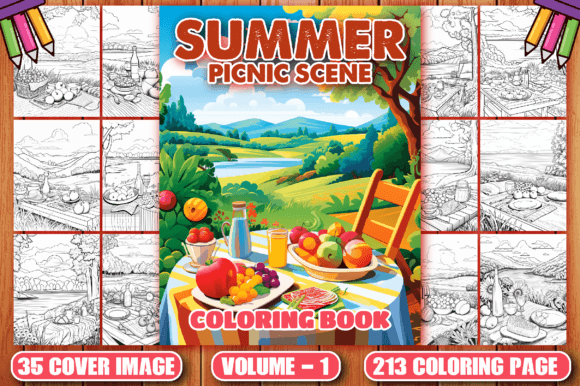
The 213 Summer Picnic Scene Coloring Pages reflect intentional design choices that prioritize both aesthetic appeal and functional flexibility. Each illustration captures a distinct moment within the broader picnic theme—think checkered blankets under dappled shade, vintage wicker baskets overflowing with fruit, children chasing bubbles near sun-dappled lawns, or couples sharing lemonade on park benches. These aren’t generic clipart-style scenes. Instead, they incorporate layered linework, balanced negative space, and subtle contextual details (e.g., crumpled napkins, folded maps, stray fireflies) that invite deeper attention without overwhelming the user.
This level of nuance supports varied coloring approaches: fine-tip pens for intricate detail work, broad markers for bold contrast, or watercolor washes over printed lines. Because all 213 pages are delivered as both print-ready PDFs and high-resolution PNG files (300 dpi), users retain full control over scaling, cropping, and layout—critical when adapting artwork for different formats like greeting cards, classroom handouts, or social media graphics.
Practical Utility Across Diverse Contexts
What makes this bundle especially valuable is its adaptability across real-world applications—not just as a coloring book, but as raw creative infrastructure.
- For Adult Colorists: The consistent A4 / 8.5×11″ sizing ensures compatibility with standard home printers and binding systems. Unlike many digital downloads that mix aspect ratios or include bleed margins unsuitable for personal printing, these pages are pre-optimized for immediate use—no cropping or resizing needed. The thematic cohesion also supports sustained engagement: returning to familiar settings (a lakeside pavilion, a rooftop terrace picnic, a backyard hammock nook) creates gentle continuity across sessions, reinforcing relaxation through visual rhythm.
- For KDP Publishers: With 213 interior pages plus 35 premium book cover designs—all formatted at 300 dpi and sized precisely for Amazon’s KDP requirements—the bundle eliminates weeks of layout prep. Each cover PNG includes transparent backgrounds and editable layers (where applicable), allowing publishers to overlay titles, taglines, or author names without compromising image integrity. The variety among covers—some minimalist and typography-forward, others richly illustrated with layered picnic motifs—lets creators test market resonance across aesthetics before committing to physical proofs.
- For Educators and Therapists: Summer-themed imagery holds strong associative value in learning environments. These pages can anchor lessons in seasonal vocabulary, cultural traditions (e.g., Japanese hanami picnics, British garden parties), or environmental science (shading patterns, plant identification, weather depiction). Therapists may use specific scenes—like a solitary figure reading beneath a tree—to gently prompt narrative reflection or emotional identification during sessions.
- For Small-Business Owners: Beyond book publishing, the PNG files serve as modular assets. A café owner could print select scenes onto coasters or menu inserts. A craft supply retailer might pair individual pages with curated pigment kits (“Picnic Palette Pack”). Even event planners have repurposed the illustrations as printable signage for outdoor weddings or community festivals—scaling elements to fit chalkboard frames or fabric banners.
Technical Readiness Meets Creative Freedom
One of the most overlooked aspects of digital art resources is technical execution—and here, the 213 Summer Picnic Scene Coloring Pages bundle excels without overcomplication. All files adhere to industry-standard specifications:
- PDF interiors are single-page, non-layered, CMYK-ready (though RGB is preserved for screen use), and optimized for fast download and reliable rendering across devices.
- PNG files maintain crisp edges at native resolution and scale cleanly up to 200% without visible pixelation—a necessity when converting from print to large-format displays or embroidery digitizing.
- Covers include safe zones and trim marks where relevant, aligning with KDP’s latest guidelines (as of Q2 2024), reducing rejection risk during upload.
This technical rigor means users spend less time troubleshooting file compatibility and more time iterating on their goals—whether that’s refining a book’s subtitle hierarchy, testing color palettes against specific paper stocks, or designing a cohesive Instagram carousel around “A Week of Picnic Scenes.”
Why Thematic Cohesion Matters More Than Quantity Alone
While “213 pages” signals substantial volume, the true strength lies in thematic consistency—not repetition. Each scene offers a unique compositional challenge: asymmetrical balance in a sloping hillside setup, perspective play in a receding pathway lined with picnic tables, or textural contrast between woven baskets and smooth glass jars. This variation prevents visual fatigue and encourages skill development across sessions.
Compare this to bundles that rely on algorithmic duplication—flipping or rotating a base image with minor tweaks. Those may inflate page counts but rarely deepen engagement. In contrast, the 213 Summer Picnic Scene Coloring Pages collection functions like a visual anthology: unified by season and setting, yet diverse in viewpoint, mood, and complexity. That distinction matters for long-term usability—especially for users who return to coloring not just for distraction, but for measurable mental reset.
Commercial Flexibility Without Legal Ambiguity
Clarity around usage rights is essential for professional adoption. This bundle explicitly permits resale anywhere—including Etsy, Gumroad, your own website, or physical markets—with no royalties or attribution requirements. That freedom extends to derivative works: adding original typography, combining scenes into diptychs, or integrating them into subscription-based digital kits. What’s excluded—appropriately—is redistribution of unaltered source files or claiming copyright over the base illustrations themselves.
This balanced licensing model reflects current best practices in the digital creative economy: empowering end users while protecting the integrity of the original asset. It also simplifies compliance for educators using pages in publicly shared lesson plans or therapists incorporating them into clinical handouts—no need to navigate murky “personal use only” clauses.
Integration Into Broader Creative Workflows
In practice, the 213 Summer Picnic Scene Coloring Pages often become part of larger workflows rather than standalone tools. Designers use individual PNGs as base layers in Procreate or Photoshop, applying custom textures or blending modes before exporting final assets. Print-on-demand entrepreneurs import selected pages directly into Canva or Adobe Express templates, pairing them with seasonal copy (“Unplug. Unwind. Picnic.”) for targeted email campaigns. Even researchers studying visual attention patterns have used subsets of the collection in controlled trials—leveraging the consistent line weight and subject matter to isolate variables like scene complexity versus emotional valence.
That cross-disciplinary utility underscores a broader shift: digital coloring assets are increasingly treated not as consumables, but as interoperable components—like fonts or stock photography—in modern creative ecosystems.
Thoughtful Scalability for Evolving Needs
The inclusion of 35 book cover designs—each distinct in tone and composition—addresses a frequent pain point: the disconnect between interior content and front-facing branding. Rather than forcing one “best” cover, the bundle offers strategic alternatives. A serene lakeside cover may resonate with mindfulness-focused audiences, while a vibrant, collage-style design better suits a playful, intergenerational positioning. Users can A/B test covers across platforms, rotate them seasonally, or even assign specific covers to sub-themes within the same book (e.g., “Backyard Gatherings,” “Beachside Baskets,” “Urban Park Picnics”).
This modularity supports organic growth. A creator launching their first coloring book might start with five covers, then expand to ten as audience feedback clarifies preferences—without needing to commission new artwork each time.
Final Considerations for Intentional Use
Like any high-quality creative resource, the impact of the 213 Summer Picnic Scene Coloring Pages depends less on inherent features and more on how those features align with purpose. For someone seeking quick, low-friction relaxation, the ready-to-print format delivers immediate value. For a publisher building a sustainable KDP catalog, the structural completeness reduces overhead and accelerates time-to-market. And for an educator designing summer literacy units, the thematic richness provides fertile ground for interdisciplinary connections.
What remains constant across all uses is the underlying invitation: to slow down, observe closely, and participate actively in shaping meaning—whether through colored pencil strokes, carefully chosen typography, or thoughtful curriculum integration. In that sense, the number “213” isn’t just a count—it’s an open-ended invitation to explore, adapt, and reimagine what a summer picnic can represent, again and again.